

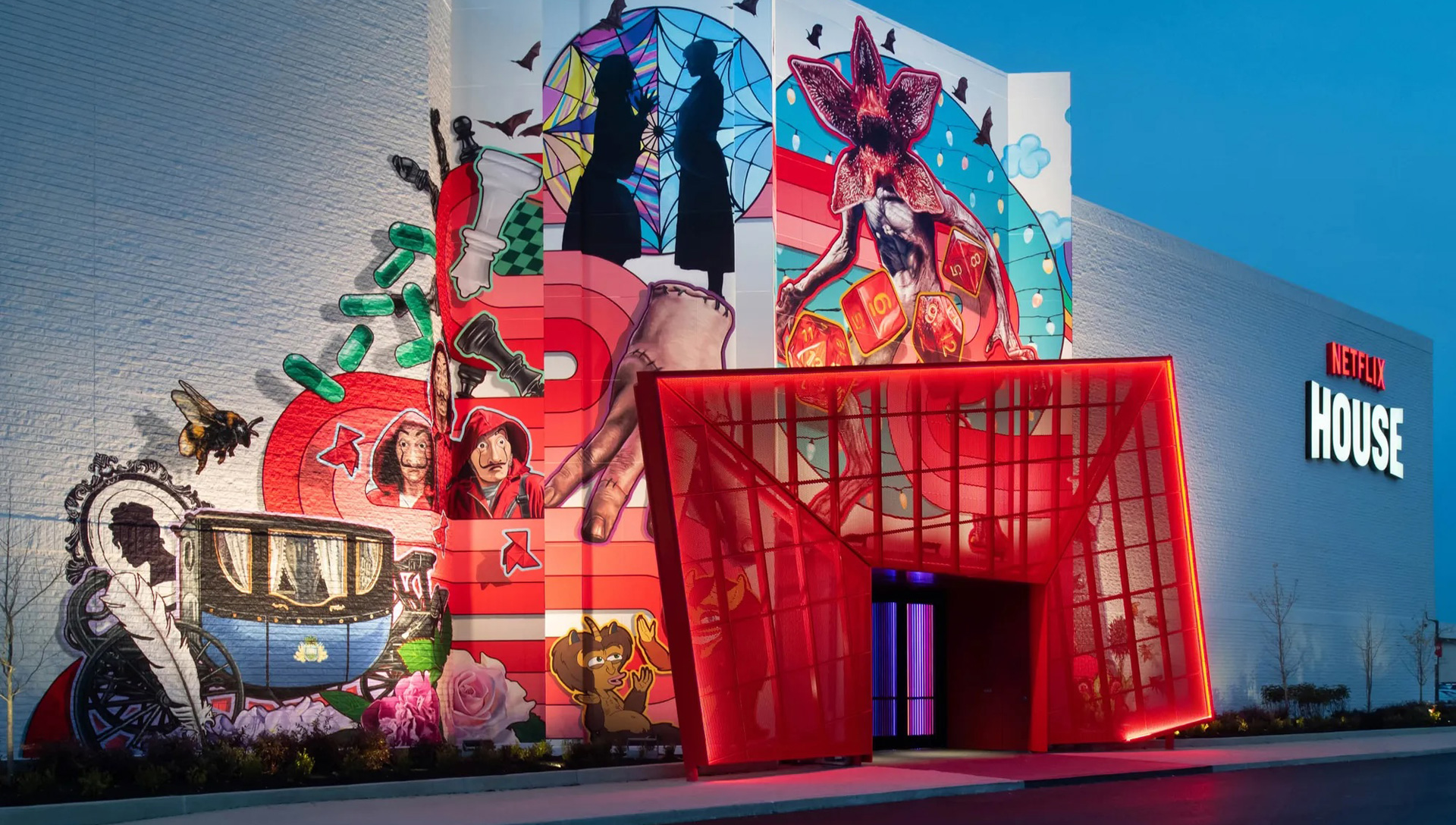
Netflix House marks a pivotal moment in Netflix’s evolution—from a purely digital streamer into a physical, experiential brand that inhabits malls and redefines how retail real estate approaches anchors, traffic, and value creation. By transforming former department store spaces into immersive “IP playgrounds,” Netflix signals that the future of content is not just watched on screens, but experienced in real life—walked through, eaten in, and shopped around.
From Streaming App to Physical Worlds
Netflix House is a chain of large-format experiential venues where fans can step into worlds from hit shows like Stranger Things, Squid Game, Wednesday, and One Piece. Visitors interact through games, attractions, food, and branded retail. Each location, roughly 100,000 square feet, has opened in repurposed department store spaces such as King of Prussia near Philadelphia and Galleria Dallas.
Inside, guests explore rotating sets, VR experiences, mini-golf, and arcade-style games alongside themed restaurants and gift shops. Admission is free, while monetization comes through ticketed attractions, food and beverage, and merchandise tied to Netflix IP.
Why Netflix is Going Offline
Netflix Houses extend a strategy that began with pop-ups, touring immersive events, and collaborations—from Netflix Bites dining experiences to Bridgerton-inspired balls—into a permanent, owned retail platform. The goal is to deepen fandom, create new revenue streams, and embed Netflix into people’s social and leisure activities, not just their screen time.
Entering brick-and-mortar gives Netflix high-impact branding, richer data on in-person behavior, and opportunities for partnerships, sponsorships, and onsite activations. It also hedges against streaming market saturation by building experiential IP businesses, akin to Disney’s theme parks and stores, but scaled for malls and designed for replication.
Impact on Malls as Destinations
For malls, Netflix House represents a new type of anchor and proof that experiential tenants can replace declining department stores while driving significant regional traffic. Locations like King of Prussia and Galleria Dallas occupy large vacated spaces, including former Lord & Taylor stores, supporting landlords’ efforts to pivot centers toward entertainment, dining, and social experiences rather than traditional soft-goods retail.
Experiential anchors increase dwell time, attract younger and more diverse audiences, and generate cross-traffic for surrounding tenants. As malls increasingly embrace the “third place” concept—a hybrid of social, leisure, and shopping venues—Netflix House exemplifies how experiential attractions can justify reinvestment and reposition properties that might otherwise struggle in a purely transactional retail model.
Implications for Retail Real Estate Strategy
Landlords and investors view Netflix House as part of a broader shift toward experiential, service, and entertainment tenants as modern anchors. Reports across North America indicate that an increasing share of new tenants in malls are experiential or service-based, reflecting a strategy to blend entertainment, dining, and retail to create resilient visitation patterns.
From a leasing and valuation perspective, these concepts can justify higher percentage rents for nearby retailers, improve NOI via increased foot traffic, and strengthen narratives for refinancing or sales based on visit-driven metrics rather than legacy anchor tenants. Specialty leasing teams gain new partnership opportunities—co-branded pop-ups, limited-time activations, and data-sharing around footfall and engagement—integrating short-term deals into a larger experiential ecosystem rather than treating them as isolated fillers.
A Glimpse of the Future
Netflix House demonstrates that the future of media consumption is increasingly hybrid: part digital, part physical, and fully immersive. For retail real estate, it reinforces a growing truth—experience is currency. As streaming platforms, brands, and landlords explore new ways to engage audiences, Netflix House is a blueprint for transforming empty retail space into cultural destinations, bridging the gap between content, commerce, and community.
Sources: Netflix, Forbes, Modern Retail, ABC7NY, Retail Customer Experience, Marketing Brew, NAIOP, Placer.ai, ICSC.
Netflix House is a chain of large-format experiential venues where fans can step into worlds from hit shows like Stranger Things, Squid Game, Wednesday, and One Piece.

